


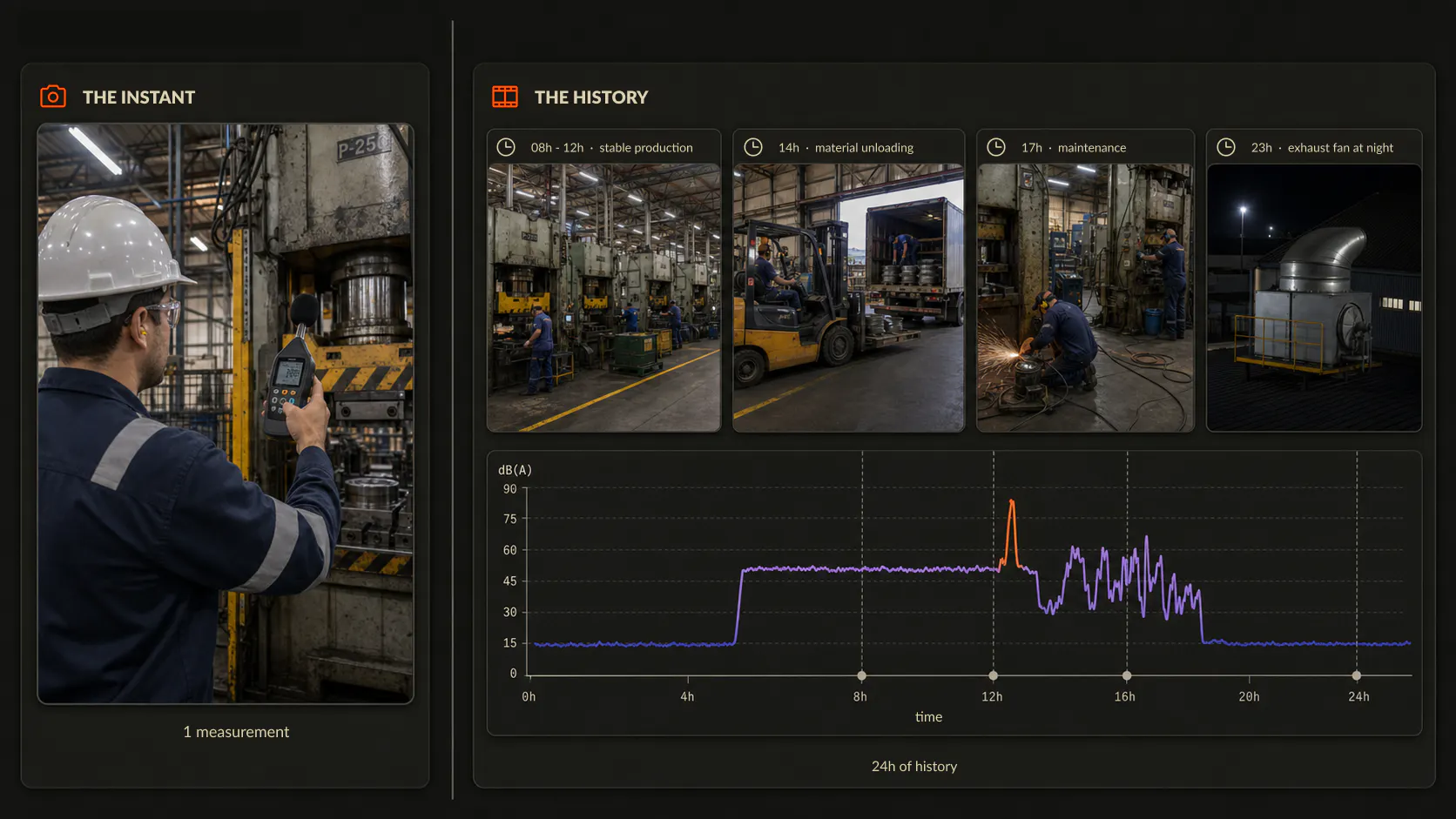
At 2 p.m. on a Tuesday, a team positions a sound level meter 1.5 m from a hydraulic press. Production is steady, the building doors are closed, and no truck is unloading coils in the yard. The result—82 dB(A)—goes into the report. Three weeks later, a resident in the neighboring complex reports peaks shortly after midnight. Maintenance discovers that a 75 kW exhaust fan operated without its silencer that night. Occupational Safety asks about exposure for the night-shift operators; the Environmental team asks about the level at the boundary wall.
Everyone is talking about "noise," but they are not asking the same question.
This scene captures a common challenge: a spot measurement is a photograph; continuous monitoring helps reveal the film. The photograph may be technically indispensable. The film adds sequence, duration, and context. Neither invalidates the other—and neither reduces noise on its own.
This guide organizes the main regulatory and technical layers for anyone who must manage industrial noise in Brazil without confusing worker exposure, community disturbance, legal obligations, and operational intelligence.
First: occupational noise and community noise are different problems
Occupational noise is the sound exposure a worker receives while performing their duties. The central question is: how much sound does that person accumulate over the workday, considering tasks, movement, breaks, and operating variations? This is why personal dosimetry follows the worker or a similar exposure group.
Environmental or community noise is the sound that reaches an inhabited area or external receiver: a home, school, hospital, or another sensitive location. The question becomes: what is the activity's sound contribution at that place and time, considering residual sound and source characteristics?
Both may originate from the same compressor, boiler, or stamping line, but they serve different purposes and use different measurement positions and criteria. An occupational result does not automatically demonstrate environmental compliance. A reading at the property boundary does not, by itself, represent an operator's noise dose.
For a closer look at the methods and acronyms, see the guide to NR-15, NHO-01, and NBR 10151. To turn data into a management routine, read how to connect the factory floor and the surrounding community.
The regulatory map: which framework answers which question
Brazil does not have a single "noise law" that resolves every industrial scenario. The applicable framework combines Occupational Safety and Health rules, environmental assessment, local legislation, licensing, and professional accountability.
NR-01: risk enters GRO and the PGR
NR-01 structures Gerenciamento de Riscos Ocupacionais (GRO) [Occupational Risk Management]. Its documented instrument is the Programa de Gerenciamento de Riscos (PGR) [Risk Management Program], which includes a risk inventory and action plan. If noise is identified as an occupational hazard, it must be addressed through this process: recognize exposures, assess risks, define preventive measures, track results, and review them when necessary [1].
This shifts the discussion from "we took a measurement" to "how does this data inform a risk decision?" The PGR is not a static file. Changes in process, equipment, layout, working hours, raw materials, or evidence that controls are inadequate may require a new assessment.
NR-09: representative assessment and the action level
NR-09 establishes requirements for assessing occupational exposure to physical, chemical, and biological agents identified in the PGR and for informing its preventive measures [2]. Quantitative assessment, when required, must be representative of exposure. In plain terms, measuring an easy or unusually quiet condition does not describe a normally more variable workday.
Under the wording in force in 2026, while NR-09 has no specific noise appendix, its transitional provisions refer to the criteria and limits in NR-15 and set the action level at half the dose. This benchmark triggers systematic controls before the exposure limit. It does not mean that any isolated reading above a certain number automatically represents a 50% dose; dose combines level and time under the selected criterion.
NR-15: unhealthy working conditions and tolerance limits
NR-15 addresses atividades e operações insalubres [activities and operations considered unhealthy under Brazilian labor law]. Annex 1 covers continuous or intermittent noise; Annex 2 covers impact noise [3]. Although Annex 1 presents a table of levels and durations rather than naming the following parameters, its criterion corresponds to a q=5 dB exchange rate and an 85 dB(A) integration threshold level (NLI, from the Portuguese term), as clarified by Fundacentro [5].
The "q" value indicates how much the level may rise for the permissible duration to be halved. Under the q=5 criterion, a 5 dB increase represents this exchange between level and duration. This is not the same calculation used in NHO-01.
NHO-01: a technical occupational hygiene procedure
Fundacentro's NHO-01 details how to assess occupational noise exposure. It uses q=3 dB and an NLI of 80 dB(A) and addresses noise dose, Nível de Exposição (NE) [exposure level], Nível de Exposição Normalizado (NEN) [normalized exposure level], the action level, and impact-noise criteria [4].
With q=3, every 3 dB increase doubles sound energy and halves the corresponding duration. Fundacentro itself explains that NHO-01 and NR-15 differ significantly and that changing NHO-01 parameters to q=5 undermines the NEN concept [5]. Therefore, results obtained with q=3/NLI 80 and q=5/NLI 85 are not interchangeable. The report must state the criterion and instrument settings.
NR-07: audiometry monitors health; it does not measure the source
NR-07 organizes the Programa de Controle Médico de Saúde Ocupacional (PCMSO) [Occupational Health Medical Control Program]. Its Annex II establishes occupational medical monitoring of hearing for employees exposed above the action levels stated in the PGR, regardless of hearing-protector use [6].
For these employees, audiometric testing must occur upon hiring, annually, and upon termination. At termination, an examination performed up to 120 days before the employment ends may be accepted, and the responsible physician may shorten the interval when justified.
Audiometry and environmental assessment play complementary roles. The former monitors the worker's hearing; the latter characterizes exposure or the environment. An audiogram does not identify which machine generated a peak. A sensor does not diagnose hearing loss.
CONAMA, NBR 10151, and local rules
For environmental noise, CONAMA Resolution No. 01/1990 establishes criteria for sound emissions from activities and refers to the technical standard for assessment in inhabited areas [7]. The current reference for fixed sources is ABNT NBR 10151:2019, corrected version 2020, according to guidance from CETESB, the São Paulo State environmental agency [8].
NBR 10151 provides three routes: a simplified method, only for continuous or intermittent sounds without tonal or impulsive contributions; a detailed method, for overall and spectral characterization, including tonal or impulsive sounds; and a long-term monitoring method, recommended for urban planning and 24-hour monitoring [8]. The latter uses descriptors representative of the relevant periods, such as Ld and Ln; it does not apply to tonal or impulsive sounds, which require the detailed method.
The standard requires a Class 1 or Class 2 integrating sound level meter compliant with IEC 61672, a compatible calibrator compliant with IEC 60942, traceable laboratory calibration, and field adjustments/checks. In ordinary measurement series, adjustment with the calibrator occurs before the series and the verification reading at the end; full-period or long-term monitoring has its own requirements for checks, weather conditions, and data processing [8]. Calling a data series "continuous" is therefore not enough to qualify it as the standard's long-term monitoring method.
The national framework does not settle every issue. Brazilian states and municipalities may have their own land-use rules, time periods, limits, and procedures. Environmental permits, agreements, and permit conditions may also prescribe specific points, frequencies, and monitoring formats. The right question is not merely "what limit is in NBR 10151?" but "which set of rules applies to this source, at this address, at this time, and under this permit?"
A short glossary that prevents major confusion
Noise dose is a percentage combining the intensity and duration of occupational exposure. Think of it as a daily budget: different periods consume fractions of that budget, and those fractions are added to estimate the dose. The result depends on the configured criterion.
NE, or Nível de Exposição [exposure level], represents average occupational exposure for the assessed period under NHO-01. NEN, or Nível de Exposição Normalizado [normalized exposure level], converts NE to a standard eight-hour workday, allowing consistent comparison with the reference criterion [5].
LAeq,T is the A-weighted equivalent continuous sound pressure level over interval T. Put simply, it condenses the varying sound energy over that period into one equivalent level. The "T" matters: a 15-minute LAeq does not automatically describe eight hours or an entire night.
LAFmax is the highest sound level recorded using A-weighting and Fast time weighting. It helps show maxima but, on its own, says nothing about duration, repetition, cause, or compliance.
Ld and Ln represent A-weighted equivalent continuous sound levels for daytime and nighttime periods, respectively. In NBR 10151, they are descriptors used by the long-term monitoring method; they are not synonyms for any freely selected average shown on a dashboard [8].
Spectrum divides sound into frequency bands. It is like replacing an invoice total with an itemized list: two events may have similar LAeq values but different spectral signatures. This information can support investigations of fans, saws, alarms, or impacts. Even so, without context and validation, similarity does not prove causation.
"We measure once a year": is that enough?
There is no universal annual frequency for every noise measurement.
"Annual" appears in the applicable audiometric monitoring under Annex II of NR-07, but it must not be copied as a generic rule for any occupational or environmental assessment. Reassessment depends on the PGR, data representativeness, process changes, control effectiveness, incidents, and local requirements or permit conditions.
A well-planned periodic campaign can answer a formal question with traceability. Its limitation is the interval between campaigns. If the factory alternates products, shifts, production recipes, speeds, or maintenance conditions, one visit may not capture every relevant condition.
This is where the photograph–film distinction helps:
- the photograph formalizes a defined sample, with a specified method, professional, instrument, and purpose;
- the film tracks trends, recurrence, and events between those samples;
- the technical decision uses each item of evidence within its limitations.
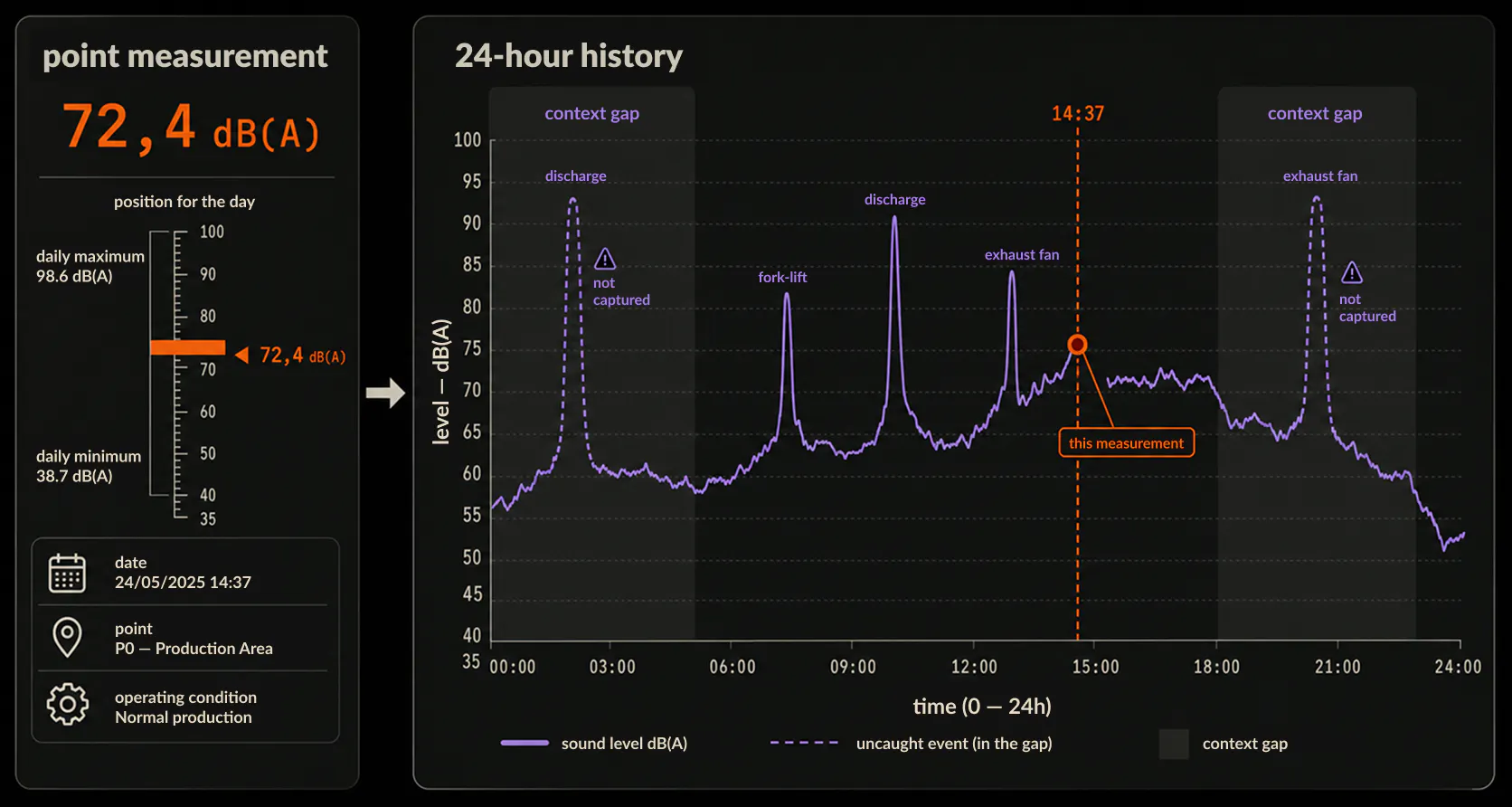
What continuous monitoring can—and cannot—do
A fixed sensor can track time series, flag pattern changes, issue alerts, compare periods, and preserve history, provided its performance and installation suit the purpose. When it measures sufficient spectral data and a validated operating-source catalog exists, it can support probabilistic source classification—for example, distinguishing the spectral pattern of an exhaust fan from the noise of trucks unloading in the yard. OTOH's embedded AI performs this classification in real time, directly on the sensor, cross-referencing spectral signatures and temporal patterns to label each event before transmitting the indicators to the cloud.
"Probabilistic" remains the key word. The AI was not present as a witness, does not control every competing source, and does not prove a causal link. The hypothesis generated by the model must be checked against production records, inspections, maintenance, and, where necessary, an assessment by a competent professional.
There are also metrological and spatial limitations. A fixed point represents the acoustic conditions at that specific location. Personal exposure varies with the worker's position and task—an operator who moves between the press and the warehouse accumulates a different dose from the colleague stationed in the control booth. Therefore, a fixed sensor does not replace personal dosimetry, a technical assessment, or an expert examination.
Long monitoring periods must also contend with rain, wind, obstructions, power or communication failures, instrumental drift, and data volume. The program must address quality, availability, and traceability—not merely collection.
On privacy, the sensor's architecture defines the risk perimeter. OTOH sensors process acoustic data locally, on the device itself, and transmit only indicators—levels, spectra, and source classifications—to the cloud. No raw audio is recorded, transmitted, or stored at any stage [9]. This approach eliminates the most sensitive vector (capturing conversations and identifiable sounds), but it does not exempt the project from a full analysis under Brazil's General Data Protection Law, the Lei Geral de Proteção de Dados Pessoais (LGPD): purpose, legal basis, necessity, transparency, access, retention, and security remain mandatory. Even without audio, acoustic indicators, metadata, and correlations may enable inferences about activities and individuals. Data governance is part of the design, not an add-on.
Measurement is not control
A data-rich timeline may improve diagnosis, but monitoring does not reduce noise on its own. Reduction comes from actions guided by the hierarchy of controls:
- eliminate or substitute the source where feasible;
- apply engineering controls—enclosures, silencers, vibration isolation, maintenance, and redesign;
- adopt administrative controls and organize times, routes, and tasks;
- use appropriate hearing protection where indicated, without treating it as an automatic substitute for collective measures.
The auditory effects of occupational noise exposure are supported by strong evidence, including noise-induced hearing loss and communication difficulties [10]. For cardiovascular outcomes associated with environmental noise, the literature and the World Health Organization (WHO) describe associations and plausible mechanisms, but effect size, individual causation, and transferability between populations remain uncertain [11]. Responsible writing does not turn an epidemiological association into a diagnosis for an individual or community.
A practical roadmap for integrating the photograph and the film
1. Separate the questions. List occupational exposure, environmental impact, operational investigation, and permit obligations on separate lines.
2. Map sources and receivers. Include machines, routes, shifts, workers, the property boundary, and sensitive neighbors.
3. Confirm the applicable framework. Review the NRs, PGR/PCMSO, state and municipal legislation, the permit, and its conditions. Record which criterion each instrument uses.
4. Plan formal assessments. Define representative groups, tasks, points, periods, calibration, the responsible professional, and the appropriate method.
5. Use time-based tracking where a real gap exists. History and alerts can help select inspection times and the events to correlate.
6. Investigate, control, and verify. Turn the signal into a hypothesis, the hypothesis into an engineering action, and the action into an effectiveness check.
7. Reassess based on triggers, not an automatic calendar. Changes and new evidence should feed back into GRO, the PGR, and environmental management.
OTOH sensors address the time-based tracking, alerts, history, and real-time source-classification stages. This does not guarantee regulatory compliance or make every facility a suitable case for continuous monitoring. The design must begin with the technical problem, not with the availability of technology.
Frequently asked questions
Is continuous monitoring mandatory in every industrial facility?
No. The obligation depends on the applicable standards, local legislation, permits, and permit conditions. It may be a voluntary management tool or a specific requirement, but there is no universal rule covering every facility.
Does a sensor inside the building replace the worker's dosimeter?
No. A dosimeter tracks personal exposure across tasks. A fixed sensor represents the location where it is installed.
Does an LAeq below a certain value guarantee compliance?
Not in isolation. You must know the purpose, period, location, method, residual sound, specific sound, tonal or impulsive characteristics, criterion, and applicable rules.
Do NR-15 and NHO-01 produce the same result?
Not necessarily. NR-15 corresponds to q=5/NLI 85; NHO-01 uses q=3/NLI 80. The results are not interchangeable.
Can artificial intelligence identify the source with certainty?
No. It classifies patterns probabilistically—indicating, for example, that an event has an 87% similarity to the spectral profile of a compressor. Confirming the cause requires cross-referencing with operational records and, when necessary, on-site inspection.
If we monitor, is the risk controlled?
No. Data supports decisions; control requires engineering measures, organization, maintenance, protection, and verification.
A next step without shortcuts
Before buying technology or repeating a campaign out of habit, diagnose the situation: which questions does your current measurement answer, which periods remain invisible, and which decisions would benefit from more context? If a relevant time gap exists, bring together HSE, Engineering, Environmental, and acoustics professionals to determine whether continuous tracking is appropriate for the scenario. OTOH offers sensors with embedded processing and AI-powered source classification—a concrete starting point for that conversation.
To continue, see how NR-1 integrates noise into GRO and the PGR (available in Portuguese), explore the methods in NR-15, NHO-01, and NBR 10151, then move on to integrated management from the factory to the surrounding community.
References
[1] BRASIL. Ministério do Trabalho e Emprego. NR-01 — Disposições Gerais e Gerenciamento de Riscos Ocupacionais [General Provisions and Occupational Risk Management]. URL: https://www.gov.br/trabalho-e-emprego/pt-br/assuntos/inspecao-do-trabalho/seguranca-e-saude-no-trabalho/ctpp-nrs/normas-regulamentadoras-nrs. Accessed July 22, 2026.
[2] BRASIL. Ministério do Trabalho e Emprego. NR-09 — Avaliação e Controle das Exposições Ocupacionais a Agentes Físicos, Químicos e Biológicos [Assessment and Control of Occupational Exposure to Physical, Chemical, and Biological Agents]. URL: https://www.gov.br/trabalho-e-emprego/pt-br/acesso-a-informacao/participacao-social/conselhos-e-orgaos-colegiados/comissao-tripartite-partitaria-permanente/normas-regulamentadora/normas-regulamentadoras-vigentes/nr-09-atualizada-2026.pdf. Accessed July 22, 2026.
[3] BRASIL. Ministério do Trabalho e Emprego. NR-15 — Atividades e Operações Insalubres, Anexos 1 e 2 [Unhealthy Activities and Operations, Annexes 1 and 2]. URL: https://www.gov.br/trabalho-e-emprego/pt-br/acesso-a-informacao/participacao-social/conselhos-e-orgaos-colegiados/comissao-tripartite-partitaria-permanente/normas-regulamentadora/normas-regulamentadoras-vigentes/norma-regulamentadora-no-15-nr-15. Accessed July 22, 2026.
[4] FUNDACENTRO. NHO-01 — Avaliação da Exposição Ocupacional ao Ruído [Assessment of Occupational Noise Exposure]. URL: https://cursos-eventos.fundacentro.gov.br/biblioteca/normas-de-higiene-ocupacional/publicacao/detalhe/2012/9/nho-01-procedimento-tecnico-avaliacao-da-exposicao-ocupacional-ao-ruido. Accessed July 22, 2026.
[5] FUNDACENTRO. Critérios para avaliação de ruído definidos pela NHO-01 — Parecer Técnico [Noise-assessment criteria established by NHO-01—Technical Opinion]. URL: https://www.gov.br/fundacentro/pt-br/acesso-a-informacao/acoes-e-programas/pareceres-e-notas/avaliacao-de-Ruido-para-fins-de-Aposentadoria-Especial/3-parecer-tecnico-fundacentro.pdf. Accessed July 22, 2026.
[6] BRASIL. Ministério do Trabalho e Emprego. NR-07 — Programa de Controle Médico de Saúde Ocupacional [Occupational Health Medical Control Program]. URL: https://www.gov.br/trabalho-e-emprego/pt-br/acesso-a-informacao/participacao-social/conselhos-e-orgaos-colegiados/comissao-tripartite-partitaria-permanente/normas-regulamentadora/normas-regulamentadoras-vigentes/norma-regulamentadora-no-7-nr-7. Accessed July 22, 2026.
[7] CONAMA. Resolução nº 01, de 8 de março de 1990 [Resolution No. 01 of March 8, 1990]. URL: https://conama.mma.gov.br/?option=com_sisconama&task=arquivo.download&id=99. Accessed July 22, 2026.
[8] CETESB. Atividades de fontes fixas — regulamentação e Manual ProAcústica/CETESB para aplicação da ABNT NBR 10151:2019 [Fixed-source activities—regulation and ProAcústica/CETESB Manual for applying ABNT NBR 10151:2019]. URL: https://cetesb.sp.gov.br/ruido-vibracao/atividades-de-fontes-fixas-regulamentacao/. Accessed July 22, 2026.
[9] OTOH. Monitoramento Sonoro Inteligente: Controle de Ruído em Obras, Indústrias e Grandes Eventos [Smart sound monitoring: noise control at construction sites, industrial facilities, and major events]. URL: https://www.otoh.com.br/blog/article/solucao-de-monitoramento-sonoro. Accessed July 22, 2026.
[10] NIOSH. Criteria for a Recommended Standard: Occupational Noise Exposure. URL: https://www.cdc.gov/niosh/docs/98-126/. Accessed July 22, 2026.
[11] WORLD HEALTH ORGANIZATION. Environmental Noise Guidelines for the European Region. URL: https://www.who.int/europe/publications/i/item/9789289053563. Accessed July 22, 2026.


